
Jonathan Mast - microAPP Factory Challenge Training
by Jonathan Mast
The microAPP Factory Challenge by Jonathan Mast is a 30-day step-by-step training designed to help beginners launch simple micro-software businesses without coding. This hands-on program guides you through market research, idea validation, no-code app building, and real product launches using practical tools and daily action tasks. With strong community support, live demonstrations, and structured accountability, participants finish with a working micro-app and real-world digital business experience. Ideal for aspiring entrepreneurs who want to move beyond theory and build something tangible, the challenge focuses on practical execution, confidence building, and creating scalable micro-app opportunities in today’s fast-growing digital economy.
Read more ↓Get this course plus 117+ more with Lifetime Access.
Get Lifetime Access – $997-day money-back guarantee · Refund Policy
WHAT'S INSIDE
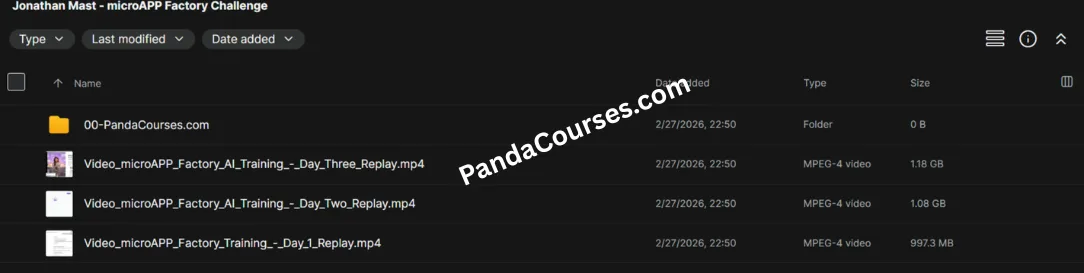
Preview of the course materials.
Course Details
Starting an online business today feels overwhelming. Endless ads promise overnight success, yet most deliver recycled tactics and shallow theory. For aspiring digital entrepreneurs who want practical skills, Jonathan Mast’s microAPP Factory™ Challenge claims to offer a structured path to launching real micro-software products without coding.
But does this 30-day training actually help beginners build and monetize a micro-app, or is it just another digital course collecting dust? This comprehensive review breaks down everything inside the program, its strengths, limitations, and whether it delivers real-world results.
What Is the microAPP Factory™ Challenge Training?
Jonathan Mast’s microAPP Factory™ Challenge is a 30-day guided online training designed to help beginners create, launch, and sell simple micro-apps using no-code tools. Instead of theory-heavy lessons, the course follows a daily challenge format that pushes participants to take action and build something tangible.
Key Facts at a Glance
Duration: 30-day guided challenge
Skill level: Beginner to intermediate
Focus: Launching and monetizing micro-apps without coding
Price: Around $497 with occasional discounts
Refund policy: 30-day money-back guarantee
Community: Private support group and live Q&A sessions
The training focuses specifically on micro-software businesses rather than dropshipping, affiliate marketing, or generic digital product creation.
How the 30-Day Challenge Is Structured
Unlike static online courses, the microAPP Factory™ Challenge uses a structured progression that unlocks new lessons daily. This pacing ensures participants implement what they learn rather than binge-watching content without action.
Days 1–5: Market Research and Idea Discovery
The first phase focuses on identifying profitable micro-app opportunities. Participants learn to analyze real-world demand using platforms like Reddit, Chrome extensions, and online marketplaces. Worksheets guide users through evaluating niches and spotting gaps.
Days 6–9: Idea Validation
Before building anything, students validate demand. This includes creating waitlists, collecting feedback, and reaching out to potential users using provided scripts. The goal is to confirm market interest before investing time into development.
Days 10–18: Building With No-Code Tools
The core of the program teaches how to create micro-apps using tools like Glide, Softr, and Airtable. Step-by-step walkthroughs demonstrate how to turn ideas into working prototypes without programming knowledge.
Days 19–25: Launch and Monetization
Participants build landing pages, set up payment systems, and launch their micro-apps using platforms such as Gumroad and Stripe. Real launch examples and conversion data help students understand what works.
Days 26–30: Growth and Scaling Basics
The final phase introduces feedback loops, feature improvements, and strategies for scaling or exiting a micro-app project.
Instruction Quality and Learning Experience
Teaching Style and Content Delivery
Jonathan Mast combines practical instruction with straightforward explanations. Lessons begin with strategic reasoning before moving into execution. Video tutorials, transcripts, and worksheets ensure clarity for beginners.
Each tool and workflow is demonstrated using real use cases rather than hypothetical examples, making the learning process accessible even for non-technical users.
Community and Support
One of the strongest aspects of the program is its support system:
Active community forum with peer feedback
Weekly live Q&A sessions
Responsive instructor and support team
Daily progress tracking for accountability
This environment helps beginners stay consistent and overcome technical or strategic obstacles during the build process.
Real-World Results and Practical Application
A major selling point of the microAPP Factory™ Challenge is its focus on producing a finished micro-app by the end of the training. Participants follow daily tasks such as building landing pages, gathering feedback, and launching small-scale products.
Many users report completing functional micro-apps during the challenge. Examples include niche productivity tools, local event apps, and simple tracking utilities. While most projects start small, the experience builds confidence and practical digital business skills.
The structured daily workflow makes it possible to complete tasks even with limited time, making the program suitable for working professionals and beginners.
Pros and Cons of the microAPP Factory™ Challenge
Advantages
Clear step-by-step roadmap from idea to launch
Beginner-friendly with no coding required
Strong community support and instructor access
Real-world micro-app creation and launch
Transparent refund policy
Limitations
Limited advanced scaling and marketing strategies
Some templates may feel repetitive
Requires consistent daily commitment
Price may be high for absolute beginners
Overall, the program emphasizes action and practical execution rather than passive learning.
microAPP Factory™ vs Other Digital Training Programs
Compared to other digital entrepreneurship courses, the microAPP Factory™ Challenge stands out for its focus on micro-software products and daily execution. While programs like Gumroad’s Small Bets Bootcamp emphasize digital products broadly, this training centers specifically on building and launching micro-apps.
Its structured 30-day roadmap and hands-on approach provide faster implementation than many theory-based courses.
Who Should Take the microAPP Factory™ Challenge?
Ideal Participants
Beginners wanting to build digital products quickly
Non-technical creators interested in no-code tools
Entrepreneurs needing structure and accountability
Anyone seeking practical experience launching micro-apps
Not Ideal For
Advanced SaaS founders seeking large-scale growth strategies
People looking for passive income without effort
Those unable to commit time daily
Final Verdict: Is microAPP Factory™ Worth It?
The microAPP Factory™ Challenge delivers a structured and practical approach to launching micro-apps. Its strongest advantage is forcing participants to move from idea to execution within 30 days. While it may not provide deep scaling strategies or advanced marketing tactics, it excels as a beginner-level blueprint for building real digital products.
For aspiring digital entrepreneurs who want hands-on experience and a clear path to launching their first micro-app, this training offers strong value. The combination of daily tasks, live demonstrations, and active community support makes it one of the more actionable entry-level programs in the digital business space today.
What Our Customers Say
Real feedback from real customers.
Tap a screenshot to enlarge.
Get all 117+ courses with one payment
Lifetime access. New courses included.
7-day money-back guarantee · Refund Policy