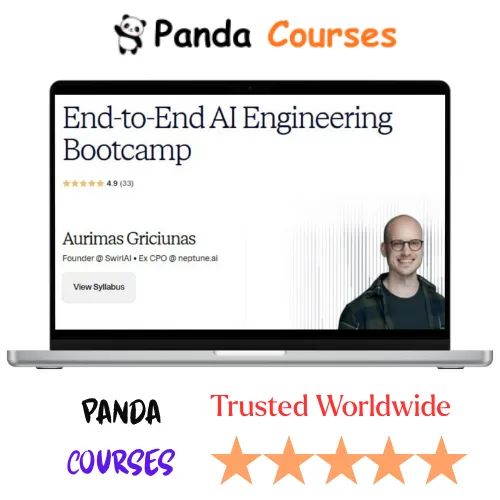
Aurimas Griciunas - End-to-End AI Engineering Bootcamp
by Aurimas Griciunas
The End-to-End AI Engineering Bootcamp by Aurimas Griciunas is an 8-week, cohort-based program designed to help engineers build production-ready AI systems instead of simple prototypes. Led by AI expert Aurimas Griciunas, the bootcamp covers the full-stack AI lifecycle, including RAG architecture optimization, agentic workflows, multi-agent orchestration, and LLMOps observability. Participants build a real-world capstone project using modern tools like GPT, vector databases, Docker, FastAPI, and Kubernetes. Through weekly engineering sprints, live sessions, and hands-on deployment training, students learn how to design, evaluate, and scale reliable AI applications for real business use cases while creating a portfolio-ready project to showcase to employers or investors.
Read more ↓Get this course plus 117+ more with Lifetime Access.
Get Lifetime Access – $997-day money-back guarantee · Refund Policy
WHAT'S INSIDE
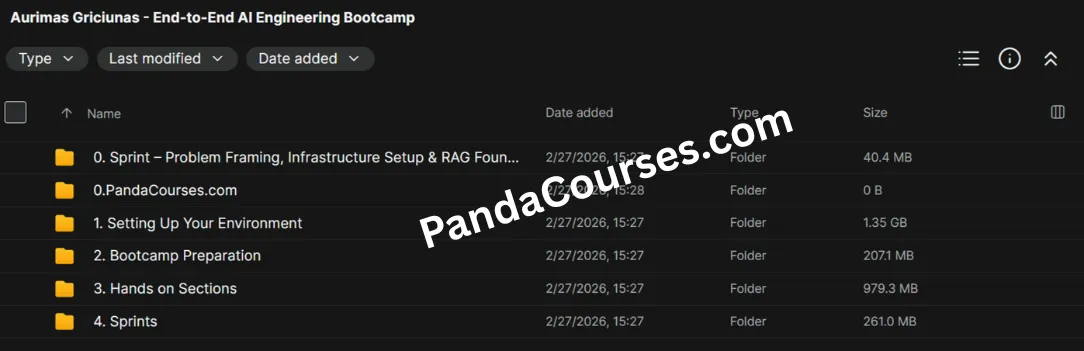
Preview of the course materials.
Course Details
The End-to-End AI Engineering Bootcamp is designed for engineers who want to move beyond experimental AI prototypes and build scalable, production-ready systems. This 8-week intensive program delivers a complete roadmap for mastering the full-stack AI engineering lifecycle, from architecture design and RAG optimization to multi-agent orchestration and LLMOps observability.
Led by experienced AI expert Aurimas Griciunas, the bootcamp focuses on transforming technical professionals into full-stack AI engineers capable of deploying resilient AI applications for real business use cases. Instead of focusing on theory alone, it provides a practical, sprint-based structure where participants build real AI products step by step.
Why Production-Ready AI Engineering Skills Matter
The Shift from AI Prototypes to Real Systems
Many engineers can build AI demos, but few can deploy scalable systems that perform reliably in production. Modern organizations require AI solutions that integrate with infrastructure, handle real user traffic, and maintain consistent performance.
This bootcamp addresses that gap by teaching production engineering fundamentals such as observability, evaluation frameworks, and deployment strategies. Participants learn how to bridge the divide between AI hype and real-world implementation.
Full-Stack AI Engineering Lifecycle
The program focuses on the entire AI lifecycle, including:
Designing RAG architectures
Building agentic systems
Implementing continuous evaluation
Deploying scalable AI applications
By mastering these components, engineers can confidently build end-to-end AI products instead of isolated experiments.
What You’ll Build During the Bootcamp
Real-World Capstone AI Project
Throughout the 8-week program, participants build a complete AI application as their capstone project. Each weekly engineering sprint introduces new concepts that are directly applied to the project.
By Demo Day, students will have:
A fully functional AI application
A deployed production system
A GitHub repository ready for employers or investors
A live demonstration of their solution
This project-based approach ensures practical learning and portfolio-ready outcomes.
Technologies and Tools Covered
Participants work with modern AI and software engineering tools, including:
LLM APIs such as GPT, Gemini, and Claude
Vector databases and RAG systems
Agent frameworks like LangChain and LangGraph
Docker, FastAPI, and Kubernetes deployment
Observability and evaluation tools
Modern communication protocols like MCP and A2A
These tools reflect current industry standards for building scalable AI systems.
How the Bootcamp Works
Weekly Engineering Sprint Structure
Each week follows a structured engineering sprint format designed to simulate real-world development cycles.
Sprint Lessons
Self-paced learning includes video tutorials, reference code, and technical guides. Participants gain foundational knowledge for each sprint.
Sprint Reviews
Live sessions provide deep technical walkthroughs, Q&A opportunities, and feedback from the instructor.
Build Labs
Hands-on coding sessions help students implement features directly into their capstone projects.
Bonus Support
Additional Q&A sessions and feedback opportunities ensure continuous improvement and technical clarity.
Core Skills You Will Learn
Designing and Optimizing RAG Architectures
Participants learn how to design advanced Retrieval-Augmented Generation systems using hybrid retrieval techniques, reranking, and synthetic data generation. These strategies help improve response accuracy and system reliability without relying solely on real user data.
Engineering Agentic AI Systems
The bootcamp teaches how to create autonomous agents capable of planning tasks, using tools, and executing workflows independently. Students learn to evolve traditional RAG systems into agentic architectures capable of handling complex queries across multiple data sources.
Building Multi-Agent Workflows
Multi-agent systems enable complex workflows where agents collaborate to solve problems. The curriculum covers:
Task routing and delegation
Agent-to-agent communication
Safeguards and evaluation strategies
Debugging and optimization techniques
These skills are essential for enterprise-level AI deployments.
Structured Prompt and Context Management
Structured prompting ensures AI outputs integrate smoothly into downstream systems. Participants learn prompt versioning, context engineering, and structured output design to maintain consistency across applications.
LLMOps Observability and Continuous Evaluation
Observability and evaluation are critical for production AI systems. Students implement:
Continuous evaluation pipelines
Performance testing protocols
Quality gates in CI/CD workflows
Monitoring tools for system reliability
These practices ensure AI systems remain stable and effective after deployment.
Deployment and Production Engineering
Building Reliable AI Infrastructure
The program covers deployment strategies using Docker, FastAPI, and Kubernetes. Students learn how to manage latency, cost, and performance while ensuring secure and scalable cloud deployment.
CI/CD and Performance Optimization
Participants implement CI/CD pipelines, semantic caching, and optimization techniques to ensure efficient production systems. By the end, they can deploy AI applications that handle real user demand. New Society.
Who Should Join This Bootcamp
Data Professionals and Analysts
Professionals looking to transition from data analysis to building production AI systems will benefit from learning deployment and infrastructure skills.
Machine Learning Engineers
ML engineers can deepen their expertise in generative AI, RAG architectures, and scalable engineering practices.
Data Engineers
Data engineers seeking to integrate pipelines with LLMs, vector databases, and agent-based systems will gain practical knowledge for AI integration.
Additional Benefits and Resources
Participants receive lifetime access to course materials, including 30+ hours of coding recordings and over 200 pages of technical documentation. The bootcamp also includes compute credits, community support, and a certificate of completion.
Students may also gain access to a talent network that connects top graduates with companies seeking skilled AI engineers.
Conclusion: Build Real AI Products That Scale
The End-to-End AI Engineering Bootcamp provides a structured path to mastering production-grade AI engineering. By focusing on real-world implementation, continuous evaluation, and scalable deployment, the program prepares engineers to build AI systems that deliver measurable business value.
For professionals serious about moving beyond prototypes and building reliable AI products, this bootcamp offers the technical depth and hands-on experience required to succeed in modern AI engineering.
What Our Customers Say
Real feedback from real customers.
Tap a screenshot to enlarge.
Get all 117+ courses with one payment
Lifetime access. New courses included.
7-day money-back guarantee · Refund Policy