
Inceptly - Modular Creative Bootcamp
by Inceptly
Build a scalable ad system that consistently produces winning creatives without relying on guesswork. This framework shows you how to structure ads using a modular approach—combining intros, bridges, and core messaging to generate high-volume variations. Learn how to script faster, leverage AI for content creation, and streamline production for rapid output. With a proven testing and tracking system, you’ll identify what works, eliminate underperforming ads quickly, and scale profitable campaigns efficiently. Instead of chasing one-off wins, this approach helps you create a repeatable process that improves over time and drives long-term growth in your advertising performance.
Read more ↓Get this course plus 117+ more with Lifetime Access.
Get Lifetime Access – $997-day money-back guarantee · Refund Policy
WHAT'S INSIDE
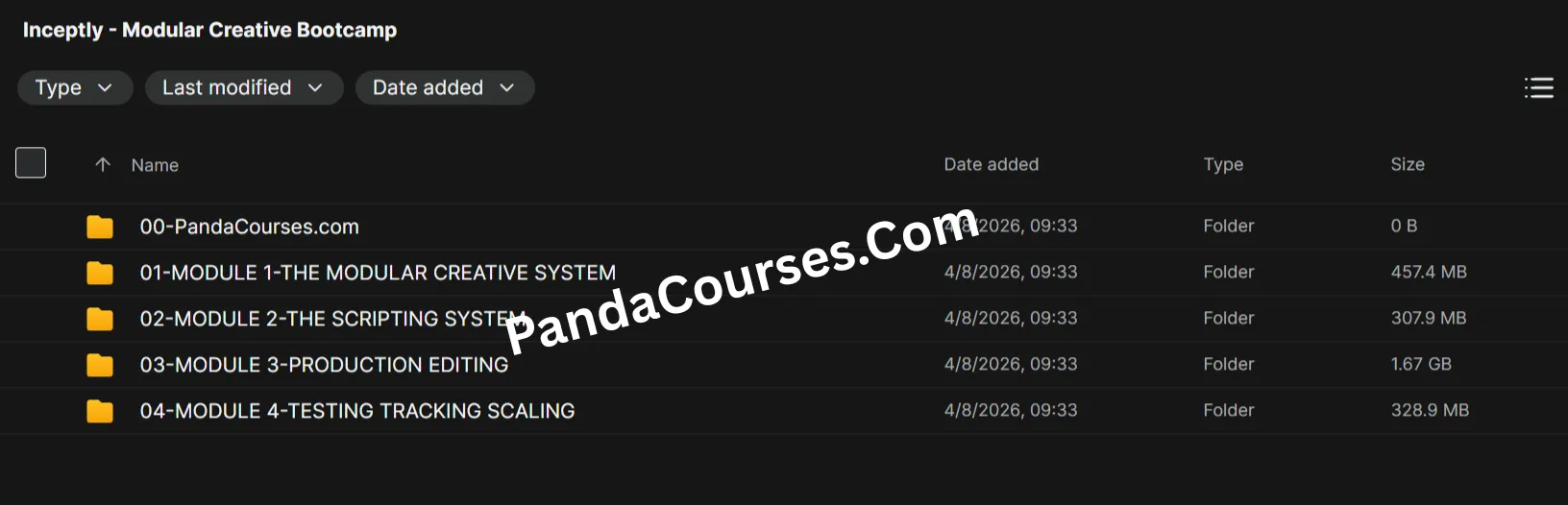
Preview of the course materials.
Course Details
If you’re running ads but struggling to consistently find winners, the issue isn’t your budget it’s your creative system. Modern demand generation has shifted the bottleneck from ad spend to creative volume. This guide walks you through a structured framework to produce, test, and scale high-performing ads efficiently. Introducing Modular Creative Bootcamp by Inceptly.
Who This Is For
This system is designed for marketers and founders who:
Spend on paid ads but lack consistent winning creatives
Struggle to analyze why ads succeed or fail
Have (or can hire) an editor to execute production
Want in-house creative control instead of relying on agencies
Are ready to implement, not just consume theory
Module 1: The Modular Creative System
Why Modular Creative Wins in Demand Generation
Traditional ad structures—like “hook + body”—no longer scale. Today, success depends on producing a high volume of variations quickly.
The 3-Part Modular Framework
Instead of linear ads, use a modular structure:
Intro – Captures attention
Bridge – Builds interest and belief
Core – Drives conversion
By breaking ads into components, you can mix and match elements. For example, 17 components can generate 100+ ad variations, dramatically increasing testing capacity.
How to Analyze Ads Using the Modular Lens
Top-performing brands don’t just create ads—they dissect them. By analyzing ads across industries like supplements, real estate, and finance, you can identify:
Missing components limiting performance
Weak transitions between segments
Opportunities to multiply output without starting from scratch
Module 2: The Scripting System
Crafting High-Converting Intros
Your intro determines whether your ad gets watched or skipped.
The Two-Layer Intro Framework
To scale intros effectively, separate them into:
Psychological Drivers (5 types): Why someone pays attention
Execution Formats (6 types): How attention is captured
This separation allows you to generate 30+ intro variations systematically instead of guessing.
Bridges & Core Messaging That Converts
Six Types of Bridges
Each bridge creates a specific belief shift:
Reframe
Mechanism
Permission
Contrast
Proof
Gradualization
Two Core Conversion Paths
Your ad’s core should follow one of these:
Logic Lock: Rational, structured persuasion
Identity Close: Emotional, identity-driven messaging
Each follows a proven 5-step structure, ensuring clarity and impact.
Building a Complete Script Set
A scalable system combines:
10 intros
5 bridges
2 cores
This structure allows you to generate dozens of unique ads from a single strategy. By reverse-engineering existing ads, you can extract reusable components and adapt them across niches.
Creating an AI-Powered Script Factory
Instead of writing scripts manually every time, build a repeatable AI workflow:
Upload niche-specific templates
Input product briefs
Generate scripts instantly
With proper prompts and labeling systems, you can connect script variations directly to performance data, enabling continuous improvement.
Module 3: Production & Editing
High-Performing Visual Formats
Creative format impacts performance just as much as messaging.
7 Proven Hook Formats
Pattern interrupt
AI-generated podcast
AI UGC (user-generated style)
Street interviews
Text-on-screen
Split screen
Motion graphics
Each format serves a different purpose depending on audience and platform.
AI vs. Human Production
Knowing when to use AI versus real presenters is critical:
Use AI for speed and scale
Use humans for authenticity and trust
Balancing both ensures efficiency without sacrificing credibility.
Batch Production & Rendering at Scale
To produce ads efficiently:
Organize components into structured folders
Use concatenation tools to assemble variations
Add music, captions, and aspect ratios automatically
With the right workflow, you can generate 100+ ads overnight.
Naming Conventions That Matter
Every file should be traceable:
Intro type
Bridge type
Core type
This makes performance analysis possible at a granular level.
Module 4: Testing, Tracking & Scaling
The Testing Framework That Drives Results
Ad performance isn’t random—it’s a system.
The Plan → Do → Check → Action Cycle
Plan: Define a clear hypothesis
Do: Launch controlled tests
Check: Analyze results
Act: Optimize based on insights
Testing should follow consistent 7-day cycles for reliable data.
Campaign Setup for Demand Generation
Key Settings for Better Performance
Minimum $200/day budget per campaign
Use Maximize Conversions for new creatives
Prefer open targeting over narrow interest groups
These settings give algorithms enough data to optimize effectively.
Naming & Tracking Systems
A structured naming system allows you to answer:
Which intros perform best?
Which bridges drive conversions?
Which cores close the sale?
Integrating dashboards ensures you can see results instantly.
Scaling Winners & Killing Losers
Decision-Making Framework
Spend $150 with no conversions → Kill
High CTR but low conversions → Fix core
Low view rate → Improve intro
This removes guesswork and speeds up optimization.
The Compounding Learning Loop
The real advantage of this system is iteration.
Each testing cycle feeds data back into:
Better scripts
Stronger creatives
Higher conversion rates
Over time, your system improves automatically, creating a compounding effect that competitors struggle to match.
Final Thoughts: Build a System, Not Just Ads
If you’re still treating ads as one-off experiments, you’re falling behind. The real leverage comes from building a repeatable system that:
Produces high creative volume
Tests efficiently
Learns continuously
Stop chasing individual winners. Build a machine that creates them consistently.
What Our Customers Say
Real feedback from real customers.
Tap a screenshot to enlarge.
Get all 117+ courses with one payment
Lifetime access. New courses included.
7-day money-back guarantee · Refund Policy